About Me

Hello everyone! Thanks for stopping by my portfolio. This is an archive of pictures and musings from my fifth block experience. Thanks to Chef Webb and my classmates, who have inspired me on this journey through chocolates, wedding cakes, and sugar.

Content

Hard Candies, Salt Water Taffy, Pate de Fruit....

Monday, December 19, 2011 0 comments
 This day we made some beautiful confections. My taffy turned out a little funky, but the lollipops with real flowers were very nice. Making taffy was an interesting process and it required some muscle to really pull all that cooked sugar. I added green coloring and some lime oil. However, I thought the lime flavor was too weak and could not really taste it. Also, salt water taffy taste best if you use sea salt and definitely do not omit it!

To the left you will see the beginnings of a beautiful, organic looking lollipop. The lollipop molds were greased lightly and filled with adornments of choice. These could include flower petals such as marigold and rose, and gold leaf. Also, for an added textural effect you can rest the lollipop mold against crinkled foil. Chef preferred the natural look of clear sugar. My partner and I added green and red. The green was a nice faint color but the red was hideous.


The next few days we made marshmallows, nougat montilimar, and PB&J chocolates. Eventually, we did have our final. I made walnut fudge, lychee pate de fruit, dipped soft caramels, dipped PB&J's, and nougat Montilimar. I did have photos of the products but a little accident with my phone rendered the photos gone.

Non-crystalline Confections

Sunday, December 18, 2011 0 comments
 Non-crystalline candy day involved many types of caramel like confections. We made peanut brittle, English toffee, and soft caramels that would later be dipped. The picture to the left shows all that I made on this particular day. The trickiest part about these types of confections is making sure you get the right balance between caramelization and texture. I struggled with cooking the soft caramels to the right texture. Initially they were hard as a rock, but a second time around I cooked them less and achieved that chew. The caramels were cut then dipped in tempered dark chocolate and garnished as desired. I just sprinkled salt on top or made a crease. For me, the tastiest confection was the English toffee. Made right it was really crunchy and had a nice buttery taste.


To the right is the variances in color for the peanut brittle. I am always amused by the simple process of caramelization but how different people cook caramels to different degrees. Even though chef did a demo for all the confections and each one had a certain temperature that needed to be reached, my classmates and I each had our variances in the cooking process. It just goes to show how something as seemingly simple as cooking caramels can actually require great skill and an eye for the transformation of sugar brought on by heat.

Intro to Crystalline Confections

Saturday, December 17, 2011 0 comments
Diverging from chocolates, the next portion of our lab focused on crystalline confections. In teams of two, we got to make penuche and fudge. As a class we made liqueur cordials, which is actually a misnomer on the syllabus because Chef Webb did all the work.

Chef Webb doing the demo on Penuche. The white clump in the middle is the vital fondant added before agitating.

The greatest part about penuche and fudge is that you are actually trying to promote crystallization by constant agitation. This builds the texture of the penuche and fudge and in order to achieve the desired firmness you have to table the products thoroughly. The penuche contained toasted pecans and we had more freedom to add our desired ingredients for the fudge. My partner and I decided to add crushed pretzels and extra salt. Our penuche was tabled adequately, but we did not cook the fudge long enough and ended up having to re-do the whole thing. The second time around the product was much firmer. Preference wise, fudge and penuche are not my favorite because I find them to be on the sweet side. However, the soft, chewy texture is great and this is an interesting method of producing candy.

Penuche, cut and ready to be wrapped
The liqueur cordials were an overnight process. Chef Webb poured the sugar mixture into cornstarch molds. After the cordials set they emerged as little morsels bursting with booze, literally. When you eat one the shells cracks and you get an initial hit of liqueur. But they are also coated in dark chocolate, which would contrast nicely with the whole candy.


Shiny gems of penuche and fudge
 After we cut the penuche and fudge into evenly portioned squares, we wrapped them in wax paper lined foil paper in various colors. The presentation was nice so long as the paper was handled gently. Also, these would make great gifts.

The First Chocolate Practical

0 comments
This was the most eventful practical yet. What started as smooth sailing, turned into a chocolate hurricane flurry towards the end. There was chocolate everywhere; including my hair. And I blame it all on my chocolate getting out of temper towards the end, possibly from a hot spot or possibly from my frenzied state.
Publish Post
Mendients with caramelized hazelnut, apricot, and chocolate balls

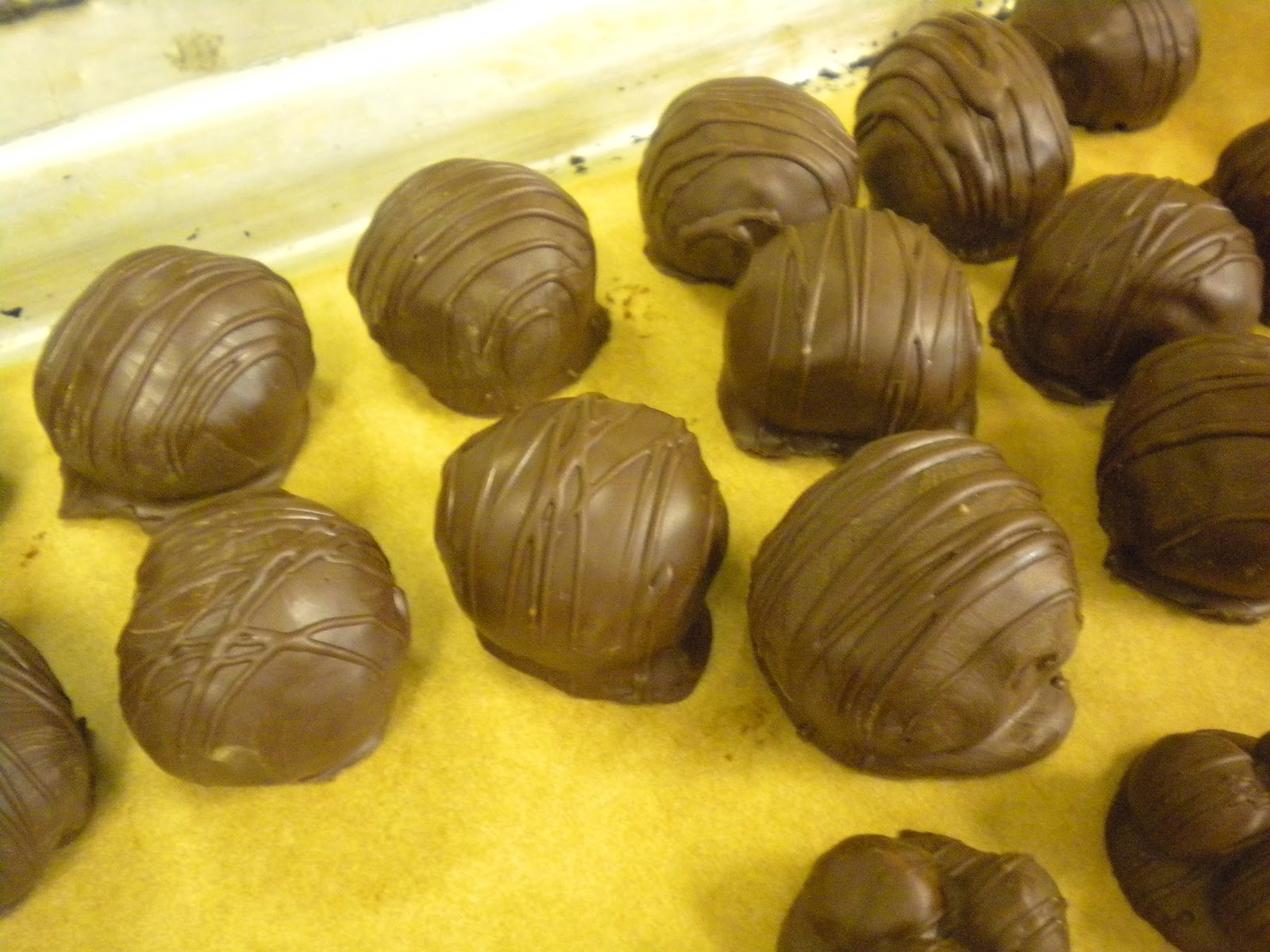
But none the less, this practical was good practice for our chocolate tempering and dipping skills. We had to make three types: dipped ferres trois, dipped apricot ganache truffles, and mendients. The focus of this practical for me was to work on getting that really nice, streak free shine and doing a clean dipping job. Well, I was so disappointed when my chocolate became out of temper and most of my truffles and dipped ferres trois came out dull! My mendients were fine at least. There were some things I could have also worked on, such as the sizing of my truffles and the neatness of my dipping. All in all, a good practical to learn from.


Ferres trois prior to coating

Ferres trois coated; lackluster shine a result of untempered chocolate

Molded Chocolates

0 comments
Day 5 devoted to the art of molded chocolate. This was one of my favorite aspects of chocolate work. I became fascinated by molded chocolates after I saw the pastry cook in charge of the chocolate program at Blackbird restaurant make some Lavender infused Chocolates cast with an iridescent purple hue. It allows you to be creative with flavor combos and the aesthetics of shape and color. Chef Webb showed us how to make two types of molded chocolates: pumpkin-caramel and passion fruit toucans. The pumpkin caramel ganache and passion fruit ganache were first made then allowed to sit at room temperature.

The process of making molded chocolates cannot be done with shortcuts and requires patience and skill. But the end process can be very rewarding. The most important first step I thought was the buffing of the chocolate molds with cocoa butter. This is what gives the chocolates that brilliant shine on the exterior. Chef advised us to buff our molds for at least a good 20 minutes. Another tip worth noting is to make sure you do not fill the molds with too much ganache; fill about 3/4 the way up.

Passion fruit ganache centers coated in white chocolate
 I tried to choose rounded molds thinking it would be easier to work with than angular ones. The shine on my toucans were okay, but I thought they could be shinier. In terms of the color, I should have stuck with just two really bright colors such as red and yellow. Three is a bit much. The pumpkin chocolates were cast into walnut shaped molds. The shine on these were pretty okay, but the shell was too thing. I also thought the bronze and silver cocoa colors on the shell was more appropriate and appealing. I was also relieved that there were no major air bubbles inside.
Pumpkin ganache center coated in dark chocolate


The most challenging aspect of molded chocolates to me is gauging how thick or thing the shell will be, making sure the molds are properly buffed enough, and foreseeing what the coloring will look like on the completed chocolate.

Dipping and Framed Chocolates, Ganache Fillings

0 comments
Days 3 and 4 we became more versed in the technical applications of chocolates. In class we made approximately three types of ganache: apricot, coffee, and praline. The latter two were used in conjunction to make a delicious Hazelnut Latte chocolate. The apricot ganache was a butter ganache using apricot jam. We used this mixture for piping. The coffee and praline ganache were layered on top of each other to create our framed chocolates. Once both the apricot and Hazelnut were set, we learned how to dip them in tempered chocolate and garnish appropriately.

The process of dipping chocolates is rather simple, but required patience. First, you have to pre-coat your individual pieces of chocolate, let it set, then give each piece a final coat. Pre-coating gives the surface a smoother appearance and shields against your dipping utensil from spearing all the way through. While dipping, I liked to periodically check my chocolate to make sure it was still in temper. The choice utensil were actual dipping tools, or a fork with the middle two tines bent backwards. Both seemed to work fine, but the fine teeth of the actual dipping fork was easier to work with sometimes.


Above is an example of a piped apricot ganache truffle. This is a rather bad example though because the chocolate used to coat was not properly in temper. The sizing and piping is rather heavy handed too. The other shapes for our ganache include our logs, pyramids, and cut framed chocolates. 

Intro to Chocolate Tempering - Mendients and Ferres Trois

0 comments

 Mendients and Ferres Trois were the first types of chocolates we made that utilized tempered chocolate, milk and dark. For the mendients and ferres, we tempered the chocolate then piped them into quarter sized disks onto the silpad using a parchment cone. Chef warned us against Thumbelina sized disks. Then an assortment of dried fruit, nuts, and seeds were inserted onto the disks-- making sure we gave each mendient the illusion of height and fullness. Ferres trois were milk chocolate disks topped with three hazelnuts. Chef told us to avoid the triangle effect, where three hazelnuts crowd onto the disk of chocolate and spread the chocolate out into a triangular shape.


After the chocolate would come to temp, we always made sure to do a test strip to be on the safe side. This involved taking a small strip of parchment and coating a bit of the tip in chocolate. If it set in a relatively short amount of time, the chocolate was at temper. I definitely had occurrences where my chocolate would come to temp but the chocolate would not set at all. Sometimes the chocolate would be tempered, but set shinier or more dull. More than anything, with tempered chocolate you want it to set with a streak-free, brilliant shine.


 Examples of fruits, nuts, and seeds we used include dried apricots, figs, golden raisins, cranberries, pistachios, macadamias, hazelnuts, peanuts, sliced almonds, pepitas, and the list goes on. You could also make some caramelized rice crispies or top the mendients off with what I call "chocolate rice crispy balls." In class chef showed us a picture of mondo sized mendients and ferres trois taken at a market in Europe.  I was inspired to search what kind of Mendients exist from France. This one was particularly eye appealing with the salt-- but I think I see...streaks.

Photo courtesy of La Chatalaine Chocolate Co.

     
Milk chocolate mendients with slivered almonds, pepitas, and dried fig
White chocolate mendients with hazelnut, pepitas, and golden raisin


Days one and two of chocolate were an alluring first look into the world of chocolate. I always thought tempering chocolate was such a necessary skill but a hard one to learn, and I was intimidated by it. Now my fear has been conquered! But there are still many nuances to chocolate that should be mastered. For example, obtaining a shiny and streak free surface, keeping your work area clean (!), and understanding the importance of chocolate and temperature.